Bolivian Climber 11 July - 1 August '15
Written by Leader Olan Parkinson, August 2015
In the weeks leading up to an expedition I have a pretty strict policy at my house; if any of my friends have so much as a runny nose, they are not allowed come round, in fact even if their kids have colds, then my house is off limits. As anyone who has suffered a cold at altitude will know, itís quite serious and the effects can severely hamper oneís performance and ability to climb high, not to mention the progressive dangers of oedema. Unfortunately, my quarantine measures can only be maintained at my house and cannot be implemented on a long-haul flight. And so it was, sat opposite a spluttering hacking mess for the entire Madrid to Lima flight, it was a foregone conclusion, a week into this trip, I too was slowly becoming a spluttering hacking mess, the cold was to develop into bronchitis and prevent me from climbing our second objective, Huayna Potosi. This was really frustrating as I was with one of the strongest teams I have had the pleasure of leading for Jagged Globe.
Mucus aside, the Bolivian climber trip is a pretty intense 22-day experience. Yes, there are a couple of days respite in the hotel in La Paz in-between climbs, but in many ways this only serves to interrupt momentum, making the following days seem more difficult than they should. The initial phase of the trip takes us to Lake Titicaca and Copacobana, a 4-hour journey to the highest lake in South America. As well as sightseeing and visiting Inca ruins on Isla Del Sol, importantly this phase is to aid acclimatisation. The effects of the altitude were being felt as soon as we landed in La Paz, just carrying and lifting kit bags exacting a toll. Our first bit of ëclimbingí came in the form of Calvary Hill, (El Calvario) replete with 13 crucifixes and lots of swearing. But as was to be the state of play for the entire trip, the team pushed through and reached the top just before sunset.
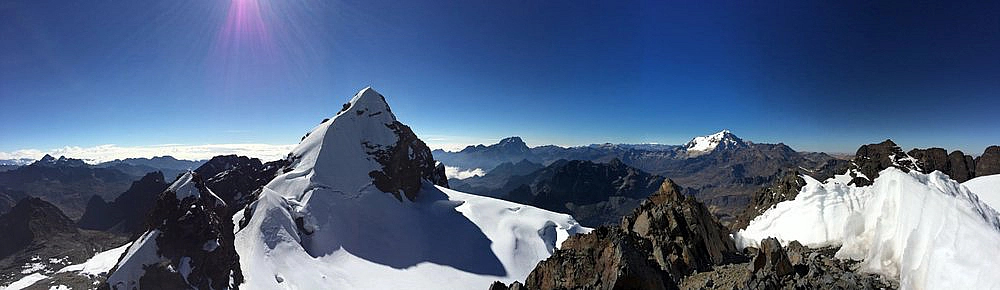
Having finished with sight-seeing and religious devotions we left the lake shores and moved on to Condoriri base camp, our staging post for Pequena Alpamayo. An hour and a half walk from the drop off point at Tuni brought us right underneath Condoriri itself and within an hourís walk of the Pequena Alpamayo glacier. The weather so far had been stable and maintaining a consistent pattern. Clear skies and no wind until the afternoon, when the winds would pick up for a little while before quieting again for the night. The nights were clear with the new moon beginning its cycle, we would have moonlight for at least part of the ascent of Pequena Alpamayo before it disappeared behind the ridge of Peak Austria. Peak Austria was our acclimatisation peak and the team dispatched it in short time, all making the summit in two and a half hours. Clear views of Huayna Potosi (aka Bronchitis Peak) and Pequena Alpamayo, as well as phone signal whiled away 20 or so minutes on the summit. The team was back down in time for lunch and spent the afternoon relaxing and sorting out tents and equipment for the coming days.
The next day was glacier training. Re-familiarising ourselves with crampon techniques and roping up for glacier travel. It was, as usual, sunny and quite warm but the team was up for it. We finished the session with ice axe arrests. Several arrests of note are worth mentioning. Roisin for her one handed surprise ice axe arrest with satisfying squeal. Andy for his ëif it doesnít work Iím going to tumble as impressively as possibleí non arrest. Chris for his ëwhatís this in my handí ice axe arrest and finally Luke for his ëwho needs an ice axe anywayí full body arrest. Happy that at least half the team could survive a slip, we headed back to camp. We had a rest day the next day and then Pequena Alpamayo the following morning. We spent some time on the rest day looking at ascending fixed lines and crevasse rescue.
Pequena Alpamayo is very alpine in character, initially involving climbing the glacier to a short ridge-line then down climbing a rock section before traversing to some steep 50-55∞ snow slopes. Conditions were on our side and the snow was soft enough to give great crampon purchase without being too soft. With fixed lines in place it was a physically demanding but really safe ascent, allowing us to really appreciate and enjoy the exposure to our right. Just as our thighs were starting to really burn the ridge angle lessens and the sun hits our faces and we can see the small summit, a few minutes on and we are standing on top. As this was our first peak, I was expecting a slow but steady ascent. It was definitely steady but definitely not slow. The entire team climbed the peak in 5 and half hours which was excellent considering we had initially allowed for 7. Everyone was back in base camp by 1pm. A brilliant first performance.
Moving on to Huayna Potosi (via LA Paz and Burger King) we had the base camp hut, more or less to ourselves. My cough had reached the very annoying stage (for everyone else) and I slept in a separate room to the team to ensure they got some sleep, I on the other hand got very little and the coughing got worse through the night, so much so that, as mentioned, I decided I should not go any higher at that time and as we had a couple of nights in the hotel in La Paz coming up I would try my best to get rid of it so I could at least give Illimani a shot with the team. The next morning the team left for the higher lodge, dispatching that particular leg in under two hours. The summit of Huayna Potosi was reached in 5 hours the following morning which again was an amazing time. Not only that, it was many of the teamís first 6000er, so happy faces all round. The team was back at base Camp by 2.30pm and back in La Paz by 4pm.
Two nights in La Paz came next to re-energise for Illimani. One evening was spent in an Asian Fusion restaurant which was excellent, the other was spent dis-proving a Trip Advisor review of another restaurant (fondue.. 2015? Really?). And so it was on to Illimani. A 4-hour drive through some very interesting rock formations located in a hidden canyon about an hour from the village of Pinaya, which is the last village we get to before the two hour trek into Illimani base camp. Base camp is expansive and we were the only oneís there. There were however some tents pitched belonging to Kenton Cool and his client who have been following us this whole trip! Our reputation obviously preceding us. They were currently up at high camp. High camp is located at the top of a rock ridge just beneath the glacier approach onto the slopes of Illimani. Even foreshortened, the route and mountain looked immense. We could pick out the route through the serac bands which led up to the ridge that then led right towards the summit hidden behind. 5-6 hours apparently.. It looked a lot, lot longer. We had dinner at about 7.30pm and then headed to bed. A 5-hour walk and scramble would get us up to high camp tomorrow.
High camp is tiny and exposed; still we managed to pitch 8 tents plus the cook tent, somehow. Not the most comfortable, some tents barely even horizontal but it was only for one night. We planned for a 3am start for the bulk of the team, but with two ropes (4 climbers) leaving at 1.30. It was cold but clear, the moon three quarters full making head torches almost unnecessary. We were the only ones on the mountain. It was really still, just the quiet squeaking of crampons, poles and axes in the snow, each rope team making its slow progress up the glacier. The hours started to pass and the temperature continued to drop. By the time we reached somewhere around 5,700m-5,750m two of the team, Rob and Aoife were having to wrestle with that decision that we have all had to deal with at some point on big mountains, whether or not to continue. Aoife was very cold and finding it difficult to breathe in the now very cold air, Rob, having being told it would still be at least 4 hours was asking himself if he had it in him to do it and make it all the way back down the mountain to high camp and then the loose, exposed rock ridge to base camp. Both took the brave and smart decision to turn around and not risk health or injury for the sake of a summit. I never cease to be impressed by climbers who make this really difficult decision themselves. It shows a real sense of self awareness, it demonstrates level-headedness and courage, that is what keeps you alive in the mountains.
The rest of the team carried on, everyone wishing for the sun to come up, it was getting really cold now, most had numb fingers and some had numb toes. It was still an hour and a half till sun-up and we were, it seemed, no closer to the ridge. The climb went on and on, the steepness never abating until finally a dull orange glow started to creep around the edges of Illimani, highlighting the top of the slope and the ridge above, soon, soon. After what seemed like an age, we crested the ridge, the sun was up! It was now only about an hour to the summit. We had reached that point of the climb where you start to really believe you are going to make it. Slowly we continued, zig-zagging up the narrowing summit slopes until suddenly, the angle leveled off, we could see the summit for the first time, yet despite that upwelling of relief and excitement, at 6,400m it was virtually impossible to speed up, so we continued to plod the last 150m until, finally, it was done, it was over, we were there, I was still coughing and it was still bloody cold, but the team had made it, we were there.
This trip was superbly supported by Grissel and her team. A great team of guides and a very hard working cook team. A successful trip can never happen without great in-country support and we certainly had that. But even more so, you need a climbing team that believe they can do what they came away to do, they need self-belief, self-reliance and be able to support each other when it gets tough, and it always gets tough. This team had these qualities in spades. I said it to them personally and Iíll say it again here, thanks for giving it everything, it was an absolute pleasure to climb with all 11 of you.
Lastly, to the Jagged Globe team. Huge thanks for the opportunity and the never ending support. Brilliant as always.
Olan Parkinson
Expedition Leader, Bolivian Climber 11th July-1st August 2015
« Previous report | Next report »
Categories
- Announcements (0)
- Blogs (0)
- News (0)
- Trip Reports (0)
- Articles (0)
Archives
- May 2026
- April 2026
- March 2026
- February 2026
- January 2026
- December 2025
- November 2025
- October 2025
- September 2025
- August 2025
- July 2025
- June 2025