Bolivian Climber - 1 to 22 August '15
Written by Leader Olan Parkinson, August 2015
Itís 3am. Itís windy again. Iím lying in my tent, restless and unable to sleep. We should be up now, putting on crampons and roping up in the dark, in the quiet, getting ready to leave high camp on Illimani. But weíre not. We are still at base camp. The tent outer flaps noisily once again. No point in trying to sleep. The decision I took to remain at base camp is sitting uneasily on my mind. Reverse heuristics going round and round in my head. Just ëcause no one else is going up does that really mean it really is too dangerous right now? As if in answer, the wind hits my tent again. Damn it, I hate the questions, just go asleep!
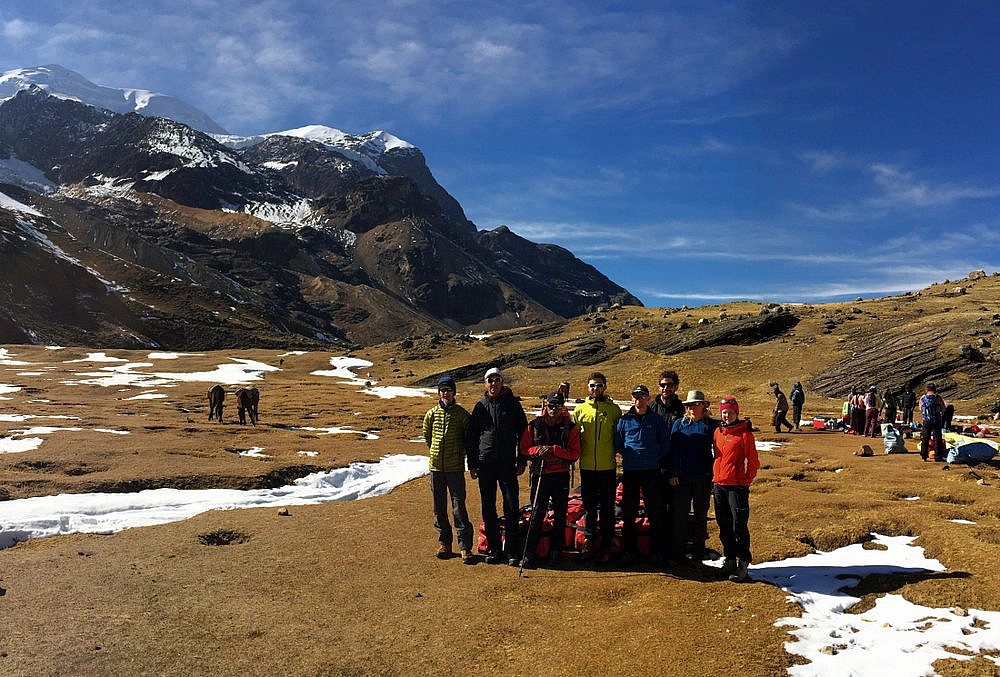
Two weeks before, after the acclimatisation phase in the Peruvian adopted, Pachamama infused Copocabana, we had moved to Condoriri base camp, dodging crowds all the way. In the six weeks I have spent in Bolivia, there seemed to be perpetual parade after parade and celebration after celebration. The Bolivians seemed to celebrate the fact that they were about to have a celebration and then, celebrate the fact that they had a celebration and so on. Condoriri base camp was all but empty. The forecast was not good. We had strong winds and snow on the way. Our first two days there were fine however and the acclimatisation peak of Point Austria was dispatched by the team in an impressive 3 hours. The weather was to hold for us for another day and we got onto the glacier below Pequeno Alpamayo for a day of skills training. These ëtechnicalí days always give the first real indication of how a team is going to perform on a trip. Walking in approach shoes and light clothing is all well and good but throw on waterproofs, harnesses, crampons, helmets and put on a movement restricting rope, throw in ice axes, just to be certain and people move very differently. But I had nothing to worry about. The weather up to this point had been stable, with lots of sunshine. This made the glacier quite icy, stripping the snow away. But everyone in the team moved confidently on this ground, happy on steeper slopes walking up them, sliding down them. We were back at base camp by 2pm and for lunch. It was a rest day the next day and the weather began to change. By lunch time the clouds had come in and it was snowing a few hundred metres above us. The winds had also begun to strengthen. Still, we made plans to go up in the morning. 3am came around quickly, despite the fact that winds fought hard to blow the tents down. In fact the wind eventually killed the dining tent, tore the outer to piecesÖ.
We stood looking up at the glacier. Even in the dark we could see the clouds rolling along the top of the glacier, obscuring Pequeno Alpamayo. A dark plume shooting off the nearby Aguja Negro. We could hear the winds above. I dread these types of mornings. Deep down I know itís probably a no-go but I delay actually saying it. The team know too but we stand there, staring, hoping that the weather will suddenly clear. The cooks have prepared breakfast, we might aswell have it. By shortly after 4am nothing has changed, so I have to call it. Itís back to our sleeping bags, and noisy, flapping tents.
Having accepted the fact that Pequeno Alpamayo was not going to happen, thoughts turned to the next objective, Huyana Potosi. This was going to be the first 6000er for many of the team. This one was important. This one was going to be difficult to get to. The snow of the past few days had stuck. The road to the hut at the base of Huayna was not covered in deep snow but in that compact glassy snow. On our approach we were told that one bus had already slid off the road and was on its side. To add some (not needed) gravity to the situation we passed several ambulances along the way. But we pushed on. Thankfully our agency had provided us with two smaller mini buses rather than a big bus. We were more manoeuvrable. We still got stuck. We reached a point about a kilometre and a half from the hut. Through the ever increasing snowfall we could see it. We were out of the buses. Talk of turning back, getting stuck, alternate itineraries, me biting my tongue, not succeeding. I had a chat with Roberto and decided we would walk, with kit bags, to the hut. See what happened. The weather was supposed to let up for the next couple of days so we had to try. Within a few hours all team members, guides and kit were in the hut. The weather had really closed in now and it was snowing heavilyÖ Well at least we were here. The next day, high camp. It was a little windy but clear enough to allow us get glimpses of the summit. We all reached the alto hut in a little over two hours. The route up to high camp was snow all the way requiring crampons for sections. Up to now the weather held, but true to form, on this trip anyway, the winds picked up during the night, so we delayed departure until 4am, it seemed to pay off and by just before 4am 5 rope teams set off. 5 hours later the team were at the summit. It was worth the gamble, 6000er no 1! (6088m to be exact, thatís important)
Itís impossible to ignore the weather when high up. Itís always there, teasing, causing doubt, frustration. Patches of snow surrounded our tents at Illimani base camp. I knew that almost 2 metres of snow had fallen higher up in the last 24 hours. The slopes leading up to and on the interminable ëstairway way to heavení section were perfect avalanche terrain, and given that the weather, up until it changed a week ago, had been hot and sunny and had, as mentioned, stripped the snow away, meant that this new snow had fallen on hard icy ground. Having not had a period of freeze-thaw this made the snowpack unstable, unpredictable and dangerous; there had been no melt to consolidate it. I knew all this, but still I lay there in my tent thinking, questioning. Itís not like we hadnít really bothered though. This morning, along with one of the local guides Jose, I went up to about 5,200m up along the approach ridge to high camp. There had been heavy cloud sitting on Illimani down to high camp at 5,500m for two days now. It was still snowing and the winds were forecast at between 50-60kph. But we had to check. We made good time, reaching the little col on the ridge in just over two hours. It was pretty evident, even from there that conditions were not right. There was deep snow on the ridge leading up to Illimani high camp which meant that there was no way our porters could carry loads up there, at least not safely anyway. We encountered a Danish climber who had spent three days camping at the col. This was his fourth and he was finally accepting that it wasnít happening for him, this time; he was preparing to go back to base camp. We then met two other climbers, coming down from further up the ridge, They had gone up earlier but were now turning back, too much snow. I looked at Jose, he knew but was waiting for me to say it. We were back in base camp an hour later.
So after 10 years of doing this, surely there is nothing more to learn. Surely there can only be so many situations and a finite number of variables to deal with, so therefore the answers and solutions to the problems that crop up are there, in your head, ready to be rolled out with absolute conviction, no more doubt. Because, mountaineering really is just a big problem solving exercise. Or maybe itís the case that there is, and should always be something to learn. I like to think so. I always say to the teams at the beginning of a trip that there should always be elements of learning on a led expedition. That I believe they should be open to learning new skills and to developing as a mountaineer. That they should feel at the end that they could come back and do this trip by themselves. So why shouldnít that apply to us, as leaders? It may not always be hard skills that we learn. Sometimes itís just admiring the determination and resolve of the team members. The way that they can accept that things just didnít go their way, this time. That even though the weather can sometimes keep going against them, that they still enjoy the trip and get the most out of it. Or the way that they can still remain positive and have a laugh, despite lack of sleep and bad weather.
Or, when a team member turns back, really close to the summit because he realises that he wonít get back down on his own, it means more to him to make it back down under his own steam, that makes him a mountaineer. Now thatís learning.
Thanks to Jagged Globe for the support and for making me stay out there for 6 weeks. As always a great team in the office.
Thanks to Grissel and Fabricio, amazing agents and some of the best Iíve had the pleasure to work with.
To our cooks and guides. Amazing team. Muchos Thankyous.
Olan Parkinson, Leader Bolivian Climber 11th July ñ 22nd August
« Previous report | Next report »
Categories
- Announcements (0)
- Blogs (0)
- News (0)
- Trip Reports (0)
- Articles (0)
Archives
- May 2026
- April 2026
- March 2026
- February 2026
- January 2026
- December 2025
- November 2025
- October 2025
- September 2025
- August 2025
- July 2025
- June 2025