Greenland Mountaineer 2023
Written by Leader Edward Chard (Ed), July 2023
It’s not unusual to adapt or change your plans as an Expedition Leader and after a fair few years of leading trips, I thought I’d encountered most things. That was up until last week when we elected to stop our sea cliff climbing session in favour of watching a pair of Humpback Whales feeding amongst icebergs of the Artic Ocean.
Two Canadians, 2 Englishmen and an American went on a trip to Greenland. It sounds like the beginning of a joke, but it best describes our small and perfectly formed team setting out from Iceland for 2 weeks of exploring the eastern coast of Greenland.
We started our journey with a 2-hour flight to Kulusuk, an East Greenlandic settlement of around 150 people. It’s quite something, as you come into land on the short gravel runway to see the water full of mini-icebergs and broken sea ice. Polar Bears inhabit the area and are a very real risk, particularly in mid-summer when sea ice has broken up and seals (their main food source) are in short supply. As soon as we left the airport for our walk down to the village centre, I took charge of our ultimate bear safety measure, a high-powered hunting rifle. It’s the only trip we run where the leader needs to have recent experience of using a rifle.
The rest of our day was spent repacking for the trip and preparing for 11 nights of wild camping.
We split the trip into 2 sections, the first being a short 30-minute boat ride away on a glaciated and uninhabited Island, the second to a very remote location 3 hours to the North with 30km long glaciers and granite spires as far as the eye can see. It really is an incredible place to visit.
Being a small team, we got to know each other very quickly. Everyone was soon discussing and debating the issues of the day. It’s one of the great pleasures of being on a trip with people from different countries and cultures that you get to hear about issues from a different perspective.
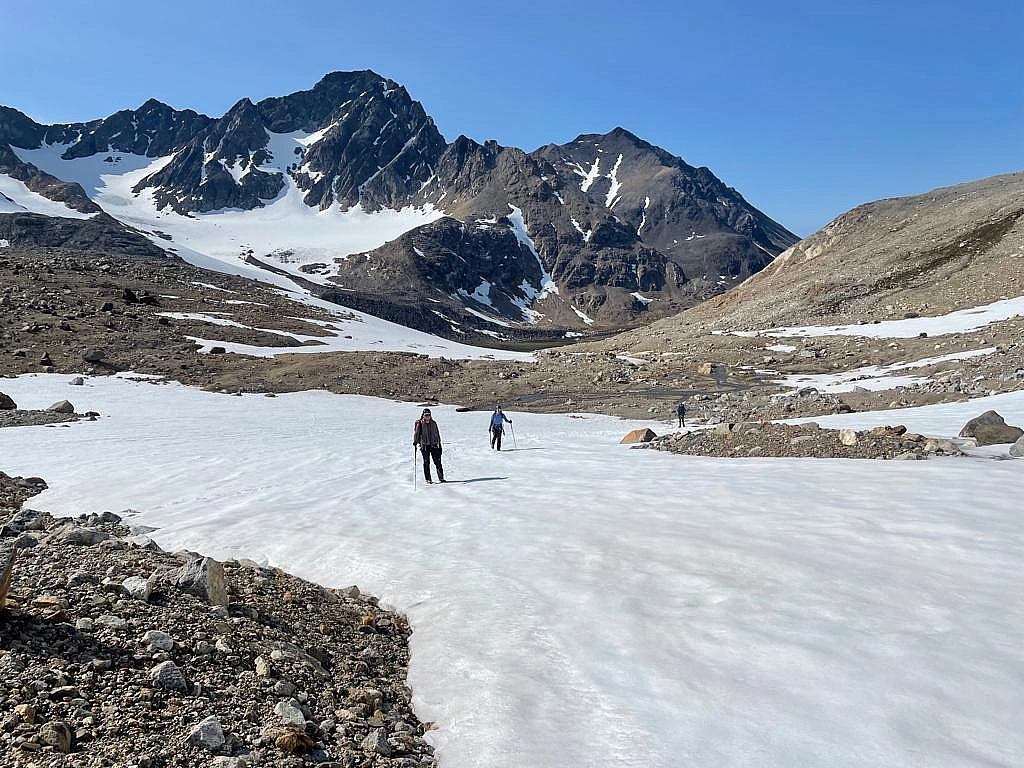
We had 2 days of practicing and revising glacier travel, ice climbing and crevasse rescue; all skills that folk had done before but important to cover as we would be ‘on our own’ for the whole trip. Getting to the summit of our first peak was special, great views from an ‘alpine’ peak with clear blue ocean and glaciers going down to the sea is quite a sight.
After a few days we relocated to a more remote camp, one that I had been to 6 years beforehand. After setting up bear tripwires and setting up the camp we went to explore. I was amazed to find that the glaciers had retreated in the short time since I was last there. Glaciers, by their very nature, change every year with the passing of winter snows but this was still quite shocking.
The following day, we attempted a small summit from a normally straight forward approach only to be turned around by unstable looking seracs and creaking crevasses. It was still a pleasure to send time on a glacier full of incredible water features like ‘Moulin’ (or glacier mill). It’s a roughly circular, vertical (or nearly vertical) well-like shaft formed where a surface melt water exploits a weakness in the ice, thousands of litres of water thunder into them every second.
Due to the vast nature of the terrain, we decided the following day we would walk and bivi high up under the stars for a night. (although there’s 23 hours of daylight in the Arctic in July so stars are in short supply!). We found a spot of stone and gravel to sleep next to the ice, it was a reasonably comfortable spot apart from the person who’s sleeping mat burst at 11pm!!
A 4.30 start saw us make the most of a cold night a stable snowpack. Unfortunately, warm air soon hit us and by 8.30 heat shimmers were already coming off the snow. We again, managed to get to a rocky col and small summit but short of the main objective. We were glad we had descended when we did as by 11am the snow was starting to give way and crevasses were opening up.
After such a big hot day, the day after, we went to visit the sea level carving face of a glacier nearby. We were, however, alarmed to discover fresh Polar Bear footprints on our journey. It’s quite something to find out you’re no longer the Apex predator in the area!! Luckily, we saw no further evidence but stayed on high alert for the rest of the time we were in there.
Due to the high temperatures, we decided to go back to camp on Kulusuk to climb hills on the main Island and climb on the sea cliffs near the village, both not needing to go over glaciated terrain. After a very cold and high-speed boat journey back, we set up camp in the middle of the island near a freshwater lake.
Bears can still be an issue in Kulusuk, so we stuck together and took the rifle everywhere, even on our last day of rock climbing.
As we were climbing, one of the team said, ‘is that a whale’, I confidently said ‘no, I think it’s ice bergs rubbing together’, how wrong I was. We spent around 45 mins watching a 12m long mother Humpback and her 6m long calf feeding on krill just offshore. A fantastic end to a fantastic trip.
We said our goodbyes in Iceland the following day, some flying home and others going to see an erupting volcano near Reykjavik. All in all, a whole bunch of adventures packed in to 16 days.
See you next year Greenland.
Ed Chard, July 2023
« Previous report | Next report »
Categories
- Announcements (0)
- Blogs (0)
- News (0)
- Trip Reports (0)
- Articles (0)
Archives
- May 2026
- April 2026
- March 2026
- February 2026
- January 2026
- December 2025
- November 2025
- October 2025
- September 2025
- August 2025
- July 2025
- June 2025